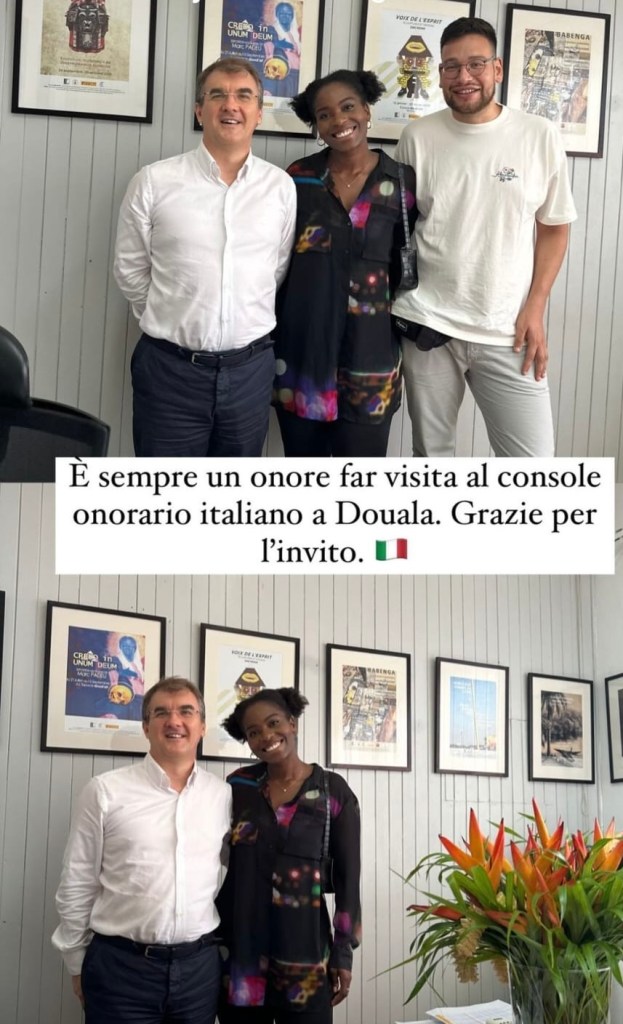
Il Console, Mauro Battistella, ha ricevuto con molto piacere la visita di cortesia della Signora Danielle Frédérique MADAM, accompagnata dal fidanzato Giacomo. L’incontro è stato un’occasione per rinnovare una relazione speciale tra l’Italia e il Camerun, come evinciamo dalle sue parole:
“Mi chiamo Danielle Frederique Madam, sono nata il 23/06/1997 in Camerun, ho 25 anni e vivo in Italia da quasi 19 anni.
Ero una ragazza ribelle, ma la mia fortuna fu quella di innamorarmi dello sport. A 13 anni, quasi per caso mi innamorai dell’atletica leggera, esattamente del getto del peso: fu un professore a notarmi in corridoio a scuola e ad invitarmi a provare.
Iniziai ad allenarmi e a capire il mio potenziale tanto che nel 2013 ottenni il minimo di partecipazione ai mondiali allievi. Partecipare ad una gara internazionale è il sogno di ogni atleta.
Quella felicità rappresentava anche una rivincita nei confronti di un’infanzia difficile e non vedevo l’ora di poter difendere i colori del Paese nel quale ero cresciuta.
Il Camerun mi cercò ma non accettai: l’Italia era il Paese che mi aveva accolta, protetta e nel quale già mi identificavo. La doccia fredda arrivò quando non vidi il mio nome tra i convocati. Non fui convocata perché non ero italiana.
Il cavillo burocratico sono stati i 10 anni passati in casa-famiglia nei quali non essendo stata registrata all’anagrafe, ho potuto avere solo il domicilio ma non la residenza, necessaria per poter richiedere la cittadinanza italiana.
Non ho, dunque, potuto rappresentare l’Italia nelle competizioni internazionali ma nel frattempo ho comunque ho vinto:
• 5 titoli di campionessa italiana (3 federali e 2 universitari)
• 5 titoli di vicecampionessa italiana
• 2 bronzi
• 1 bronzo assoluto
• 14 titoli di campionessa regionale lombarda assoluta
Il 30 aprile 2021, ho giurato fedeltà alla Repubblica e sono, così, finalmente diventata cittadina italiana: “È stato il giorno più bello della mia vita”.
Nonostante le difficoltà economiche non ho comunque abbandonato gli studi, mi sono sempre data un gran da fare, durante gli anni dell’università facevo diversi lavori per mantenermi ma soprattutto per continuare a fare atletica ad alto livello.
Mi sono laureata il 22 dicembre 2022 e ora lavoro nel campo della comunicazione.
Parlo spesso della mia storia perché mi rendo che potrebbe aiutare ed incoraggiare altre persone, soprattutto quando vado nelle scuole: dico ai giovani che nulla è perduto e che se vogliono possono riuscire a fare tutto quello che vogliono.
Parlo alle donne, dico loro che possiamo essere quello che vogliamo, che gli ostacoli si affrontano e poi si superano. Parlo alle bambine dicendo loro che possono fare tutti gli sport che vogliono, inclusi quelli tipicamente riconosciuti da “maschio” che l’importante è divertirsi e avere un sogno. Parlo delle giovani e del loro approccio alle materie STEM, che vale il discorso degli sport, non ci sono limiti, noi donne possiamo arrivare dovunque”.
La prego di prendere nota, che la SEDE OPERATIVA dell’ EUROCHAM in CAMERUN si trova DOUALA dove di fatto si svolgono tutte le ATTIVITA’ IN PRESENZA. Nell’articolo precedente, con il quale si è presenta l’organizzazione, è stata resa nota solo la sede legale in Yaounde.
La informo sull’ EUROCHAM: la Camera diCommercio Europea in Camerun. Nata nell’anno 2020, su iniziativa di un gruppo di dirigenti per associare le imprese europee presenti sul territorio camerunense, dal mese di aprile 2023, EUROCHAM fa parte delle rete mondiale delle camere di commercio europee, con sede a Bruxelles.
EUROCHAM è presieduta da Yanis ARNOPOULOS ed ha un consiglio di amministrazione composto da 14 membri: espressione multisettoriale delle più importanti attività economiche europee.
Il Presidente, Yanis ARNOPOULOS
AGISCO PER:
1. Rappresentare le piccole, medie e grandi imprese in Camerun presso le autorità politiche, le associazioni di categoria e le istituzioni diplomatiche.
2. Promuovere le imprese europee presenti sul territorio camerunense nonché le relazioni commerciali tra il Camerun e l’Unione Europea.
3. Apportare competenza tecnica alle imprese e alle istituzioni pubbliche camerunensi ed europee.
4. Aiutare gli investitori europei che intendono installare un azienda in Camerun.
5. Migliorare le condizioni per favorire gli investimenti
ADERISCO PER:
1. Diventare membro di una rete importante di soggetti economici
2. Avere un supporto per azioni efficaci di lobbying
3. Sviluppare e condividere esperienze e conoscenze professionali
4. Sviluppare attività economiche e trovare dei partners
Il nuovo canale di comunicazione di EUROCHAM: la Newsletter che informa sugli eventi e sulle novità della camera di commercio; sugli aderenti e le loro imprese e sullo stato dell’economia del paese.
Le trasmettiamo il messaggio del Vice Presidente del Consiglio e del Ministro degli Affari Esteri e della Cooperazione Internazionale per la Commemorazione del 67° Anniversario della Tragedia di Marcinelle.
8 agosto 2023
Care Italiane e cari Italiani all’estero,
è con grande emozione che oggi commemoriamo la tragedia di Marcinelle, nel suo 67esimo anniversario.
In ricordo delle 262 vittime di 11 nazionalità diverse – e di cui 136 erano nostri connazionali – che persero la vita nell’incidente minerario.
È dal 2001 che l’8 agosto, nella data dell’anniversario di Marcinelle, si celebra anche la “Giornata nazionale del sacrificio del lavoro italiano nel mondo”.
In questo spirito, ho voluto essere personalmente qui a Marcinelle, a nome del Governo, per portare omaggio ai milioni di italiani che vivono fuori dai confini nazionali e, in particolare, ai connazionali caduti sul lavoro, mentre contribuivano alla crescita economica, sociale e culturale dell’Italia e dei Paesi che li avevano accolti.
Questa triste ricorrenza mi tocca personalmente nel profondo: ho passato parte della mia infanzia all’estero ed ho trascorso diversi anni della mia carriera politica nelle Istituzioni europee. Più volte, negli anni scorsi, anche nella mia veste di Presidente del Parlamento Europeo, mi sono recato a Marcinelle.
Il Bois du Cazier è il luogo simbolo delle sofferenze e della fatica dei nostri connazionali. Il sacrificio di quei minatori ha contribuito a rafforzare la consapevolezza dell’importanza di assicurare adeguate garanzie e sicurezza sul lavoro.
Una data che il Governo italiano vuole sottolineare quest’anno in modo solenne. Abbiamo voluto rendere speciale la commemorazione di oggi con l’omaggio del sorvolo nei cieli di Marcinelle di due Tornado dell’Aeronautica Militare italiana, di cui ricorre il centenario.
Un modo per essere più vicini alle nostre comunità, una testimonianza di forte amicizia delle nostre Forze Armate che ogni giorno riempiono tutti gli italiani di orgoglio, lavorando per la sicurezza di tutti noi, in Italia e nei teatri internazionali.
Il Belgio è un Paese in cui c’è stata una forte emigrazione italiana, fin dagli anni 20 del secolo scorso e in particolare a partire dal secondo dopoguerra, e che ancora oggi accoglie molti italiani presenti nel mondo accademico, nel settore dei servizi così come in quello delle imprese e della ricerca scientifica.
La tragedia di Marcinelle ha avuto un ruolo cruciale nel gettare le fondamenta dell’Europa di oggi e della cittadinanza europea, ispirata ai valori condivisi del rispetto per la dignità umana, dell’uguaglianza, della democrazia e della libera circolazione dei lavoratori.
Valori che oggi, più che mai, sono indispensabili per affrontare insieme le sfide globali e assicurare pace, stabilità, sicurezza, crescita economica, prospettive per i giovani.
La commemorazione di Marcinelle è innanzitutto per tutti noi il dovere della memoria. Un dovere che onoriamo con convinzione ogni anno, anche per rendere omaggio al contributo di tutti gli italiani che sono emigrati all’estero per ragioni di studio o di lavoro e degli italo-discendenti, che con l’iniziativa del “Turismo delle Radici”, parte qualificante del nostro PNRR, vogliamo riavvicinare all’Italia.
A tutti i connazionali all’estero, in questa importante giornata, rinnovo il mio più sincero ringraziamento, per la passione e l’impegno con cui, quotidianamente, continuate a rendere l’Italia sempre più protagonista nel mondo.
Gentile Utente, auspicando di farle cosa utile e gradita, pubblico questo articolo a cura di Massimo Zaurrini, direttore della rivista “Africa e Affari” apparso sul sito dell’ISPI, il 3 agosto 2023:
“ The Italian economic approach toward Africa has changed over time. More and more companies, associations and institutions are venturing into the continent, extending their focus beyond North Africa as well.
To evaluate the evolution of Italy’s economic presence in Africa, in terms of both trade and investments, it is best to narrow the focus on a specific period – the past decade – where there has been a quite evident change.
A data point and an image well illustrate this evolution. Let us start from the former. In 2013, there was only one office of ICE (Italy’s national foreign trade agency) for all of sub-Saharan Africa, and that was in Johannesburg, South Africa. In 2023, considering the upcoming openings expected in July, there are eight ICE offices in Sub-Saharan Africa: Johannesburg, Accra (Ghana), Addis Ababa (Ethiopia), Dakar (Senegal), Lagos (Nigeria), Luanda (Angola), Maputo (Mozambique), and Nairobi (Kenya). Moving to the latter, the image refers to the Macfrut Fair, one of the biggest Italian and international events for fruit and vegetable machinery. In 2013, although Africa was mentioned in one of the conferences on the sidelines of the Fair, Africa’s presence was fairly limited, while the theme did not even seem to arouse the interest of the operators present at the event. In 2023, on the other hand, Africa was playing a central role at Macfrut. Its presence was palpable in the audience that crowded the conferences dedicated to the continent, among the buyers who went around the stands, and, above all, among the exhibitors. There were cumulative stands organised by the ICE, national stands (an entire pavilion divided between Ghana, South Africa and Nigeria) and stands of single companies.
Italy’s presence in the region: more pronounced, more diversified
Generally speaking, it can be said that the Italian business world’s approach to the continent has changed in recent years. It has gone from being mistrustful to being more curious, with a growing number of companies, associations and institutions that have begun to push their gaze beyond nearest North Africa. In the past, only a limited number of Italian companies worked in Africa, and they had a specific focus, such as large groups in the energy sector, those active in construction, and major infrastructural projects. Alongside these players, small and medium-sized companies have made their way into a variety of sectors: from agriculture to processing, from new technologies to pharmaceuticals, from engineering to food, as well as fishing, livestock, textile, components and, of course, the machinery sector.
In 2022, an interchange worth more than EUR 68 billion was recorded. This figure was up sharply from the previous year, mainly due to imports from Africa, which almost doubled from EUR 24 billion to EUR 47 billion. Italian exports also reached a peak of 21.3 billion euro in 2022. On the import side, purchases of raw materials, especially energy, have been of great importance, enhancing the role of supplier countries such as Algeria, Libya, and Egypt in North Africa, and Angola, Mozambique, Gabon, Ghana, and Congo in sub-Saharan Africa. According to recent data on exports made available by the ICE, investment goods continue to prevail: especially machinery, but also electrical material and pharmaceutical products.
Despite recent growth, however, the unexpressed potential remains very large, considering that Africa could absorb far more than the current 3.4% of total Italian exports. Nevertheless, the macroeconomic data on interchange do not yet seem to register the same change of pace highlighted at the beginning. The Statistical Yearbook of Foreign Trade 2022 (the latest available, with the next release at the end of August) produced by ISTAT and the ICE shows, starting from 2012, a certain static nature in terms of trade magnitude. In 2012, Italian exports to Africa amounted to almost 19 billion euro, compared to 21.3 billion euro in 2022. Similarly, Italian imports from Africa in 2012 amounted to €35.2 billion compared to €47 billion in 2022.
The investment puzzle
Italian investments are a different issue. During the last decade, Italy has set some positive records in this field. In 2015, the country (according to a report by Ernst&Young) was the leading investor with $7.4 billion (10.4% of the total FDI to Africa that year), while in 2016 Italy was the first European investor. However, the statistical snapshot provided by the investment data should be interpreted with extreme caution, as these can easily be ‘drugged’ by individual projects in ‘capital intensive’ sectors, i.e. those sectors that require large amounts of capital to get started. The most ‘intensive’ of these sectors is undoubtedly the energy sector: the operation of a group with the capacity of ENI, the leading Italian oil and gas operator in Africa, is capable of determining fluctuations in the graphs of Italian investments in Africa. And it is no coincidence that of the 7.4 billion in investments in 2015, over 6 billion was what ENI had earmarked that year for the natural gas development project in the Zohr field in Egypt.
The most recent figure, confirmed by the Bank of Italy and ISTAT, refers to 2021. It registers a contraction of Italian investments in Africa of approximately EUR 1 billion, over 40% less than the 2017 figure. Undoubtedly, the pandemic, followed by conflict, and finally the difficulties in the financial field have cooled the general investment environment at a global level. According to the Bank of Italy, the return flows from Algeria (minus 862 million), Egypt (minus 237 million) and Ghana (minus 213 million) had a major impact on the Italian figure in Africa in 2021. On the other hand, investments in Angola (EUR 87 million), South Africa (EUR 60 million) and Tunisia (EUR 40 million) were positive highlights. In any case, the recent drop is not enough to reverse a trend that has been constant for 7-8 years now. According to the 2015 OECD report ‘Italy & Africa deepening economic ties’, in fact, Italian investments in Africa were decreasing in the period from 2009 to 2014 and Italy was ranked 17th, overtaken among others by Greece, Spain and Switzerland. Thus, the data of recent years confirms a strengthening of the economic partnership between Italy and Africa.
Additionally, as already pointed out, it must always be remembered that the macro-data snapshot on investments provides a picture that is only partial.
It is evident, in fact, that the investment – for example – in Senegal of a medium-sized company active in the production of melons is a small fraction of an investment project by the hydrocarbon giant. And yet, the impact that such an enterprise generates in ‘familiarising’ the entrepreneurial fabric with Africa would be of great worth. It will cascade into the radar of competitors and players in the supply chain, bringing countries that were hitherto absent, causing a chain of growing interest and links, whose results, in terms of numbers and statistical data, will be seen in a few years’ time.
It is also important, however, to highlight some elements that are still missing to push that “army” of Italian small and medium-sized enterprises (SMEs) and create a group of sufficient weight to make a statistical impact. The growing political will to see Africa as an economic partner, proclaimed in words by many governments, must be implemented by supporting medium-sized Italian companies intrigued by the continent. Players from all over the world have long had a presence in the African market. Competition from companies from all European countries is fierce, as well as from China, the United States, Turkey, Israel and Brazil. And many Italian SMEs complain above all about difficulties on the economic-financial side. The absence of major Italian banks from the continent and the prudence or mistrust with which, as per its mandate, the Italian export credit agency, SACE, categorises most African countries makes it more difficult for SMEs to operate. On this front too, something has moved in recent years, but perhaps more could be done. An attempt could be made to set up an Italian system capable of facilitating the arrival in Africa of more medium-sized Italian industries that could also represent a turning point for the African economic system. Looking ahead, in fact, Africa has already traced its path: the one marked by the African Free Trade Area (Afcfta). The project is taking its first steps and will reach maturity in 10-15 years. But Afcfta is designed to make Africa a free market, first and foremost, for African producers. To add value and process goods and services for sale on the continent, African entrepreneurs need machinery and expertise that Italian SMEs are able to offer. A final element that points to a further change in economic relations between Italy and Africa in the near future is linked to the very nature of the forthcoming economic revolutions. If, until the third industrial revolution, Africa seemed to be structurally lagging behind other parts of the world, the fourth seems to have the potential to bring productive realities closer together with a convergence of potential and interests.
Si ricorda agli utenti e alle utenti che, dal 3 luglio 2023 le domande di visto per l’Italia e per gli appuntamenti per l’Ambasciata, finalizzati all’ottenimento di molteplici servizi, quali i ricongiungimento famigliare, devono rivolgersi alla società di servizi BLS INTERNATIONAL, https://blsitalyvisa.com/cameroon/.
Indirizzo a Douala
Centro commerciale “L’ATRIUM” , supermercato SPAR, al 1° piano, dopo il negozio di valigie “DELSEY”.
I messaggi scritti dagli e dalle utenti sul blog sono pubblici, qualora si preferisse mantenere la riservatezza, si consiglia di scrivere agli indirizzi di posta elettronica: consolato.douala@gmail.com consolato.douala@email.it



 VICE CONSOLATO ONORARIO D'ITALIA